A4 · Portrait
210 × 297 mm · ISO 216
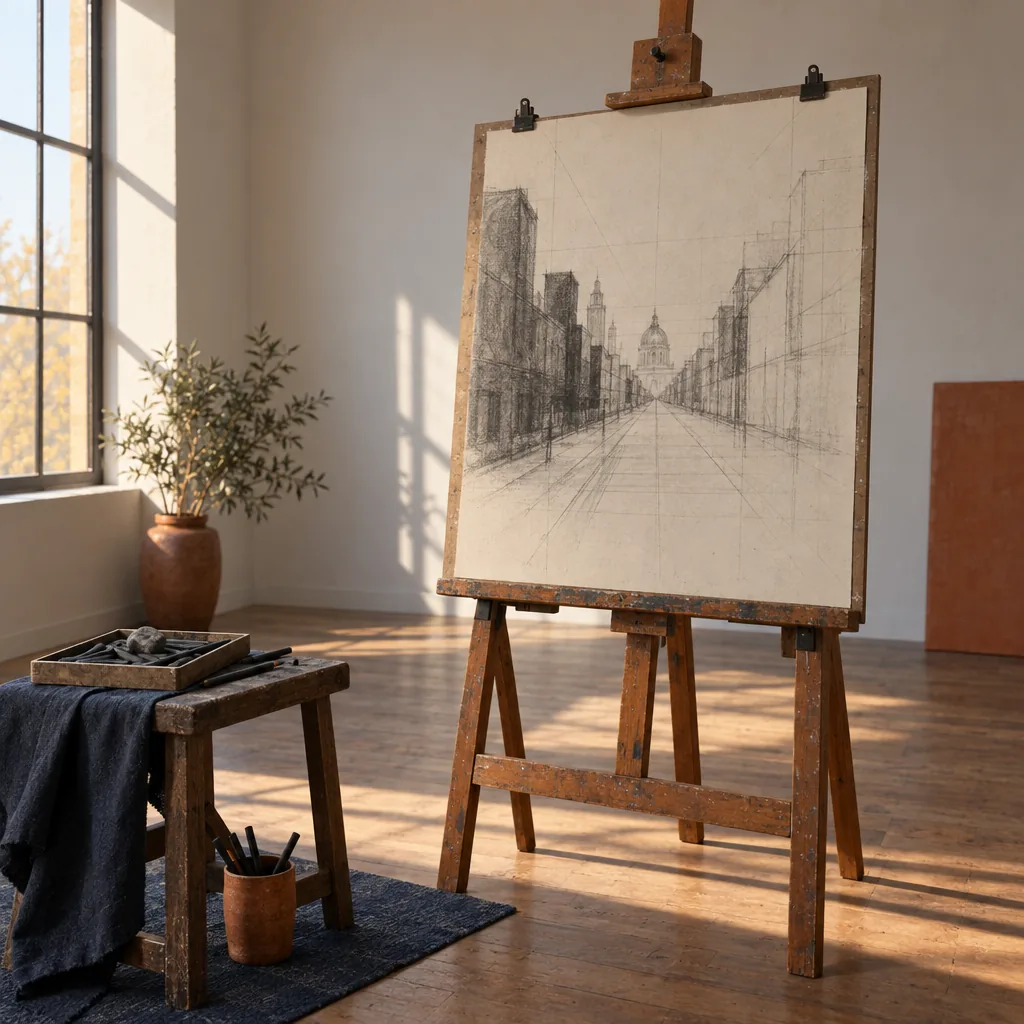
Two horizon vanishing points plus one above or below - towers and atria.
Three vanishing points form a wide triangle: two on the horizon and a third either far above (a worm's-eye view looking up at a tower) or far below (a bird's-eye view looking down into a courtyard or atrium). The result is the most dramatic of the perspective grids and the only one that honestly represents tall buildings observed from street level. Further reading: A practitioner reading list covers the standards lineage in more depth.
Three-point construction rules drawn from "Drawing for Architecture" (Léon Krier) and standard delineation textbooks.
Three-point perspective was largely the invention of 19th-century theatre and panorama painters; it became architectural shorthand for "tall" once skyscrapers gave designers something genuinely vertical to draw.
Every variant on this page is delivered as a vector SVG with physical millimetre dimensions baked into the file, so a compliant printer driver will reproduce it at exact 1:1 scale by default. Choose the sheet size that matches your printer tray, set scaling to 100 % (never "fit to page"), and verify with the calibration check on our how-to-print guide. Buyer's guide: Comparing the major architectural scale rulers can help you pick the right physical scale rule to use over the printed grid.
210 × 297 mm · ISO 216
297 × 210 mm · ISO 216
297 × 420 mm · ISO 216
420 × 297 mm · ISO 216
420 × 594 mm · ISO 216
594 × 420 mm · ISO 216
216 × 279 mm · ANSI A
279 × 216 mm · ANSI A
216 × 356 mm · US Loose
356 × 216 mm · US Loose
279 × 432 mm · ANSI B
432 × 279 mm · ANSI B