A4 · Portrait
210 × 297 mm · ISO 216
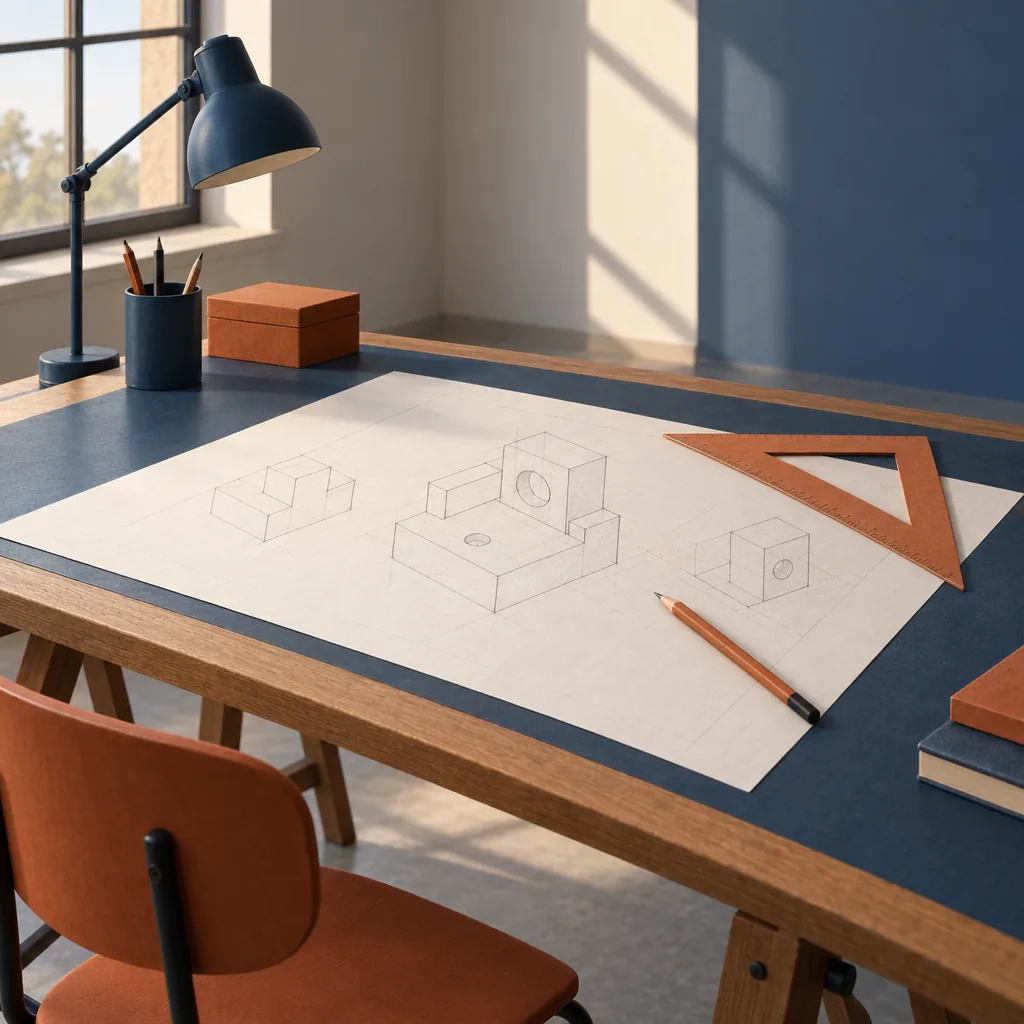
The textbook isometric grid - three axes at 120°, 5 mm cell pitch.
A true isometric grid with all three principal axes inclined at 30° from horizontal and spaced exactly 120° apart. Equal foreshortening on every axis means a 5 mm cell drawn on paper represents 5 mm on every face of the modelled solid, removing the perceptual stretch that plagues casual axonometric sketches. Further reading: A practitioner reading list covers the standards lineage in more depth.
Aligns with the isometric projection convention described in ISO 5456-3:1996 and the British Standard BS 8888 pictorial drawing recommendations.
Isometric projection was formalised by Sir William Farish in 1822 as a teaching aid for engineering apprentices at Cambridge - long before computer modelling, the 30° grid let draughtsmen explore three-dimensional ideas with nothing more than a pencil and a triangle.
Every variant on this page is delivered as a vector SVG with physical millimetre dimensions baked into the file, so a compliant printer driver will reproduce it at exact 1:1 scale by default. Choose the sheet size that matches your printer tray, set scaling to 100 % (never "fit to page"), and verify with the calibration check on our how-to-print guide. Buyer's guide: Comparing the major architectural scale rulers can help you pick the right physical scale rule to use over the printed grid.
210 × 297 mm · ISO 216
297 × 210 mm · ISO 216
297 × 420 mm · ISO 216
420 × 297 mm · ISO 216
420 × 594 mm · ISO 216
594 × 420 mm · ISO 216
216 × 279 mm · ANSI A
279 × 216 mm · ANSI A
216 × 356 mm · US Loose
356 × 216 mm · US Loose
279 × 432 mm · ANSI B
432 × 279 mm · ANSI B